I used Claude Code to build a deep learning pipeline that classifies cat breeds using EfficientNetV2 with test-time augmentation. Separately, I trained the same dataset on Google Cloud Vertex AI AutoML to compare the two approaches. Dataset: Oxford Pet IIT, filtered to 12 cat breeds with ~200 images each.
Training pipeline
I used a two-phase training approach: freeze the backbone for initial epochs, then unfreeze for fine-tuning with discriminative learning rates. Early runs hit ~100% training accuracy but only 60-65% validation, a classic overfitting problem. I also ran into Lambda's missing Nvidia drivers, which kept the training falling back to CPU.
After fixing the drivers and adding regularization, the model improved significantly:
- Label smoothing. Softened targets to prevent overconfidence.
- Mixup / CutMix. Blended images and labels for better generalization.
- Cosine LR schedule. Warmup plus cosine decay for stable training.
- EMA weights. Averaged parameters over time for smoother convergence.
- Discriminative LR. Lower rates for the pretrained backbone, higher for the classifier head.
The biggest improvement came from switching to EfficientNetV2-S at 320px. Cat breed classification is a fine-grained task, so the higher resolution helped distinguish subtle differences between breeds.
Results
Final model: 95% macro F1 with strong balance across all 12 breeds. Test-time augmentation added an extra 1-3% accuracy boost. You can test the model yourself here.
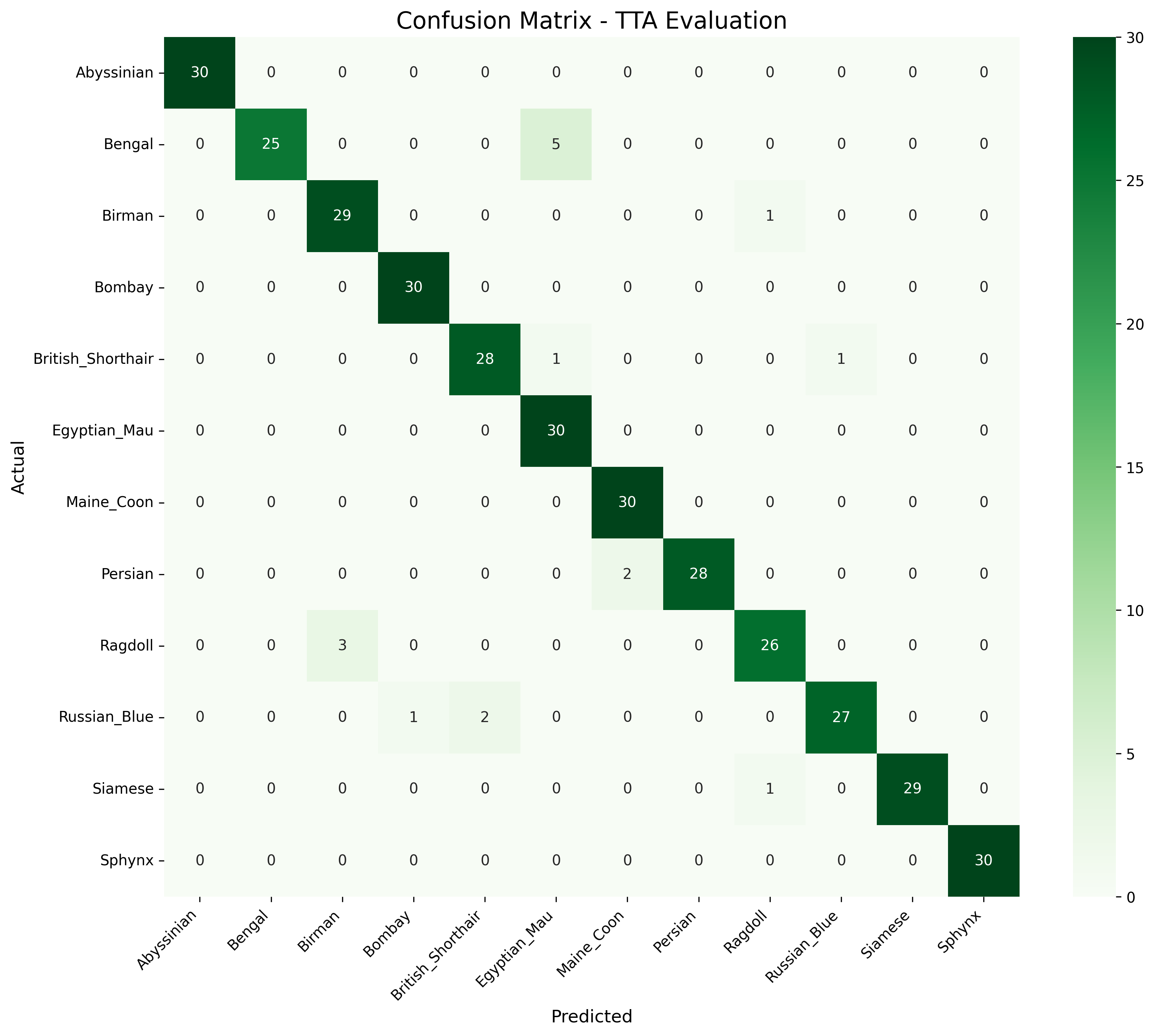
The Vertex AI AutoML model trained from scratch over 24 hours and also performed well:
- PR AUC: 0.984
- Precision: 97.3%
- Recall: 90.7%
Tech stack
- Python, PyTorch, timm — model training
- EfficientNetV2-S at 320px — backbone architecture
- Google Cloud Vertex AI — AutoML benchmark
- Lambda Labs — GPU compute